Why Selling a Book Proposal Is Smarter Than Writing a Book

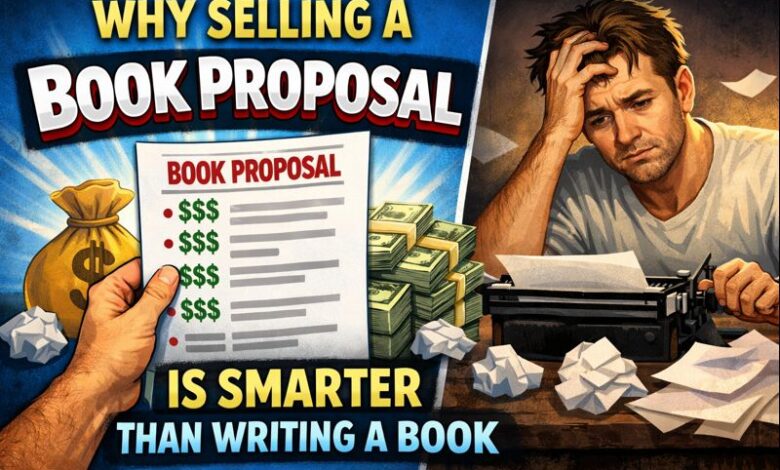
Why Selling a Book Proposal Is Smarter Than Writing a Book
For decades, aspiring writers have been given the same advice: write the book first, then try to sell it. While this sounds reasonable, it is often the slowest, riskiest, and most discouraging way to build a writing career—especially in non-fiction publishing.
Professional writers know something most beginners don’t:
Selling a book proposal is often far smarter than writing the entire book first.
This is not a shortcut or a publishing trick. It is the standard professional method used by journalists, consultants, educators, and experienced non-fiction authors. Publishers prefer proposals because they reduce risk, improve positioning, and increase the likelihood of success.
The Romantic Myth of “Write First, Sell Later” – Selling a Book Proposal
Many writers fall in love with the romantic image of writing: working in isolation, following inspiration, believing that great writing will eventually be discovered.
Publishing, however, does not operate on romance.
Publishing operates on risk management.
A beautifully written book that no one wants to buy is still a financial loss. Publishers do not reject books because they dislike writers—they reject books because they do not see a clear market.
Writing a full book without testing the idea is like building a house without checking whether the foundation is solid.
Publishing Is a Business Before It Is an Art
Traditional publishing is a high-cost business. Each book requires investment in editing, proofreading, cover design, formatting, printing, storage, distribution, sales teams, and marketing.
Most physical books are sold on consignment. Unsold copies are returned and often destroyed. When a book fails, the publisher absorbs the loss.
Because of this risk, publishers want to know whether a book can sell before it is written.
This is why proposals exist.
What a Book Proposal Really Is – Selling a Book Proposal
A book proposal is not a manuscript, not a summary, and not a rough draft.
A book proposal is a business document designed to sell the idea of your book.
Its purpose is to prove:
- There is a real audience for the book
- The topic is relevant right now
- The author has credibility or experience
- The book has commercial potential
When a publisher believes in a proposal, they offer a contract and an advance—before the book exists.
Why Writing the Full Book First Is Risky
1. You Might Write the Wrong Book
Without market validation, writers often create books that are too broad, too narrow, poorly positioned, or outdated by the time they are finished.
A proposal forces clarity before commitment.
2. Emotional Attachment Becomes a Problem
After spending years on a manuscript, writers struggle to accept feedback that suggests major changes—or rejection.
A proposal allows early correction without emotional burnout.
3. Time Is Lost If the Book Is Rejected
Writing a full book can take months or years. A rejected proposal costs weeks, not years.
4. Financial Stress Kills Creativity
Writing without pay creates pressure and anxiety. Stress reduces creativity and focus.
Selling a proposal often leads to an advance, allowing writers to work with stability.
The Power of Getting Paid Before Writing
When a publisher buys a proposal, they usually pay an advance—upfront money against future royalties.
This transforms writing from a gamble into paid professional work.
Advances provide:
- Financial support
- Professional validation
- Clear deadlines
- Confidence and motivation
Even a modest advance confirms that the idea has real value.
Why Publishers Prefer Proposals
Lower Risk
Proposals allow publishers to test market demand before heavy investment.
Better Positioning
Publishers can refine titles, subtitles, audience focus, and marketing angles early.
Collaboration From the Start
Editors and marketing teams can guide the book before it is written.
A Proposal Forces Professional Thinking
Writing a proposal forces writers to think clearly and strategically.
It answers:
- What promise does this book make?
- Who is the reader?
- Why does this book matter now?
- How is it different from others?
This clarity often leads to a stronger book than one written without direction.
Why Non-Fiction Thrives on Proposals
Non-fiction books sell solutions, insight, and transformation.
Publishers need to understand the problem, the audience, and the value clearly.
This is why business, self-help, health, education, and memoir-with-message books are almost always sold through proposals.
The Psychological Advantage for Writers
Selling a proposal first offers powerful emotional benefits:
- Confidence from professional validation
- Motivation from a signed contract
- Reduced fear of rejection
- Clear direction and purpose
Writers stop asking if the book is worth writing—because the answer is already yes.
Common Myths About Book Proposals
- Myth: Only famous writers sell proposals
Truth: Unknown writers sell proposals every day - Myth: Proposals limit creativity
Truth: They focus creativity - Myth: Writing first proves dedication
Truth: Strategy proves professionalism
When Writing the Full Book First Makes Sense
Writing first may be appropriate for fiction, poetry, experimental work, or memoirs without a defined audience.
But for most non-fiction writers, proposals are the smarter path.
For more insights on selling book proposals and navigating the publishing world, check out these resources:
- Writer’s Digest – How to Sell a Book Proposal
- Jane Friedman – The Business of Being a Writer
- Reedsy – How to Write a Book Proposal
- BookBaby – Book Proposal Templates
- The Creative Penn – Should You Write a Book Proposal First
- Writer Unboxed – Selling Proposals
Final Thoughts
Writing a book is a major investment of time and energy.
Selling a proposal first protects that investment.
Instead of hoping your book will sell, you validate the idea, get paid upfront, and write with confidence.
Selling a book proposal is not avoiding the work.
It is choosing the smartest order to do the work in.
Smart writers don’t write books and hope.
They sell ideas first—and write books that are already wanted.